Home | Introduction | Towering buildings | Masterful curving construction | Fine details | Nuraghi across Sardinia
About the Barumini site
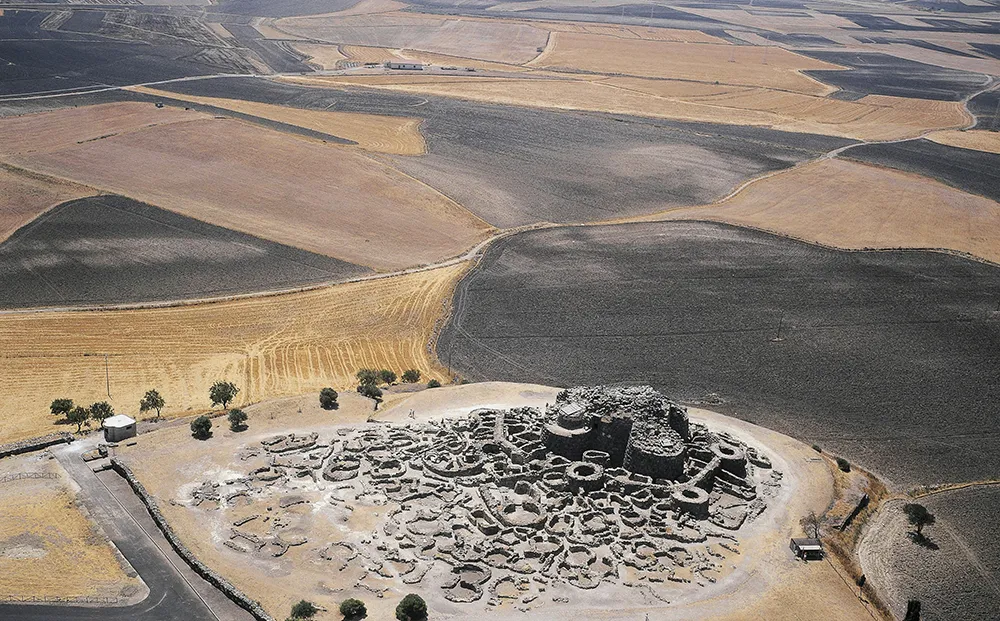
The archaeological complex of Barumini was designated as the first UNESCO World Heritage site on the island of Sardinia because it is the most complete example of a nuraghe (a unique type of Bronze Age building complex).
The stone tower of a nuraghe is instantly recognizable: a truncated cone shape that is—in some locales—surrounded by turrets and walled enclosures, it has no parallel anywhere in the world. A nuraghe might have been a simple dwelling, an elite residence, a defensive structure, even a ritual building.
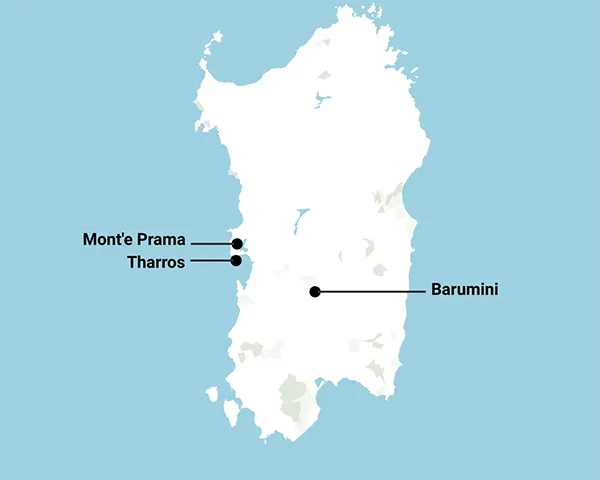
Sardinia has approximately 7,000 nuraghi; the most ancient of these probably appeared in the Middle Bronze Age (between 1700 and 1600 B.C.E.). This UNESCO-listed complex, called Su Nuraxi in Sardinian, is a majestic structure that dominates a vast plain (alongside present-day Barumini). The first published record of Su Nuraxi is from 1834; more than a century elapsed before it was described, in 1938, by the distinguished archaeologist Giovanni Lilliu, who examined its position, layout, and structure. Lilliu worked throughout the 1940s and 1950s on the excavation.
According to his work and that of others, the original nucleus here was built in the Middle Bronze Age (1500–1300 B.C.E.) and a large village of huts developed around it in the following centuries.
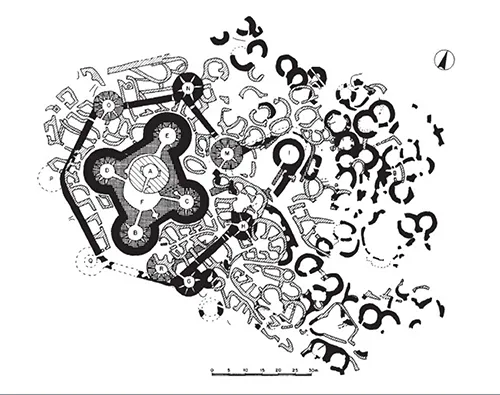
Su Nuraxi consisted of a massive central tower—Tower A, originally over 18 meters (some 59 feet) high—with three chambers, one atop the other, and a terrace supported by stone corbels. In the Recent Bronze Age (1300–1100 B.C.E.), this central tower was surrounded by four others (Towers B, C, D, and E) oriented to the four main compass directions. These four towers were lower, with only two stacked chambers each.
Tower B stands at the south side of the site’s bastion, enclosing and protecting both the keep and the courtyard. The wall in the lower of its two chambers has a double order of slits to bring in light and air.
Tower C is to the east. The upper of its two chambers was equipped with a silo.
In Tower D, to the west, visitors to the lower chamber can admire the excellent condition of the double order of wall slits (nine on the lower level, eight above).
Even more slits can be seen in Tower E, to the north—eighteen openings in all. The center of its chamber has a circular well.
Outside this bastion of four towers surrounding Tower A was a wall with eight towers.
Beyond the wall was the village, built mostly in the Final Bronze Age; its circular dwellings each had a conical wooden roof over a single room.
At the beginning of the final period of Nuragic civilization—in the Iron Age (ninth–sixth centuries B.C.E.)—much of Su Nuraxi was destroyed; a new settlement arose on its ruins at the beginning of the seventh century B.C.E.
In the fifth century B.C.E., the Nuragic civilization gave way to the Punic occupation, and in the second and first centuries B.C.E. this settlement was also used by the Romans. During this Punic-Roman period, many structures were reused or modified, and new rooms were built. The Su Nuraxi area was probably in use until the sixth or seventh century C.E. and then abandoned.
Over more than 2,000 years, people living at Barumini created a site with rich cultural stratification. Although Sardinia has many other impressive nuraghi, Su Nuraxi remains the finest symbol of this distinct archaeology and architecture.
Barumini was included on UNESCO’s World Heritage list in 1997 for its “outstanding universal value.” The site met three selection criteria (in the words of the designation):
- The archaeological site of Su Nuraxi di Barumini is the preeminent and most complete example of the remarkable prehistoric architecture known as nuraghi.
- The Su Nuraxi di Barumini bears exceptional testimony to the Bronze Age civilization of Sardinia and evolution of the political and social conditions of this prehistoric island community over many centuries.
- The property of Su Nuraxi di Barumini is the outstanding example of a nuraghe, unique megalithic defensive structures and associated settlements illustrative of the imaginative and innovative use of the materials and techniques that took place in the prehistoric island society of Sardinia in the middle-late Bronze Age.