80 Years of the Italian Republic
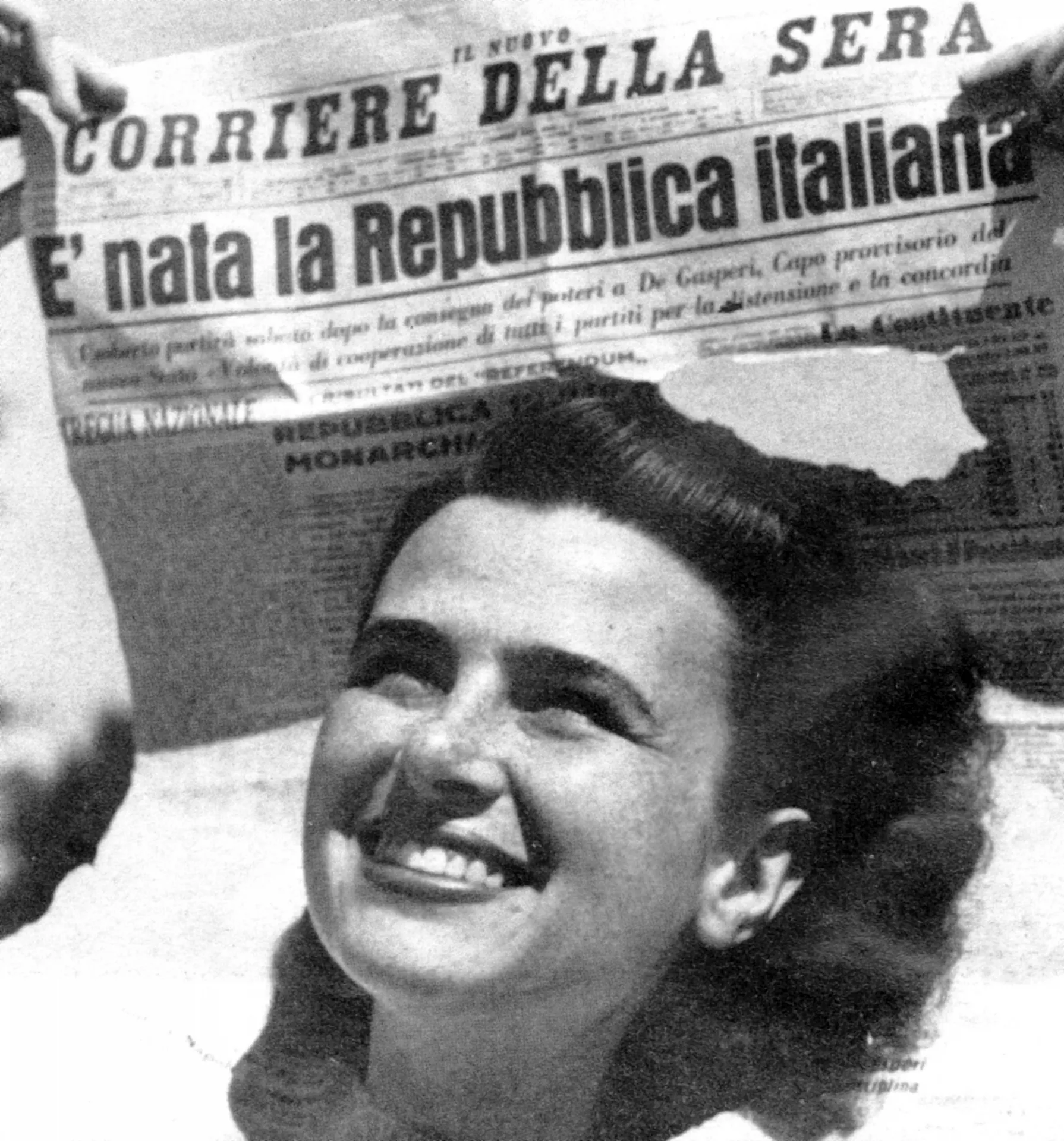
In 1946, Italian voters chose a republic over a monarchy. The Italian Academy marks the anniversary with a dialogue between Lucia Rubinelli and Nadia Urbinati (who spoke here last year with NYU's David Forgacs in Liberation! 80 Years Since the End of World War II in Italy).
Opening remarks
Barbara Faedda, Interim Director, Italian Academy for Advanced Studies, Columbia University
Speakers
Lucia Rubinelli, Assistant Professor of Political Science, Yale University
Nadia Urbinati, Kyriakos Tsakopoulos Professor of Political Theory, Columbia University
Click here to register.
This event is part of the Italian Academy’s “Rule of Law” initiative, conceived by Barbara Faedda, which includes the 2023 roundtable People, Rule of Law, and Supreme Courts Now, the 2024 dialogue Tales from the Legal Front Line: Philippe Sands in conversation with Monica Hakimi, and two events in 2025—the dialogue Liberation! 80 Years Since the End of World War II in Italy (with David Forgacs and Nadia Urbinati) and the symposium Universal Rights in Practice: International Frameworks and Domestic Legal Systems—as well as the 2021 collection of essays titled Rule of Law: Cases, Strategies, and Interpretations.
ABOUT THE SPEAKERS
Lucia Rubinelli is Assistant Professor of Political Science. Before joining Yale, she held positions as Junior Research Fellow in the History of Political Thought at the University of Cambridge, Robinson College and as Fellow in Political Theory at the London School of Economics.
Her primary research interests include the history of nineteenth and twentieth century European political thought, democratic theory, and constitutional theory.
Her first book Constituent power. A History (CUP, Ideas in Context, 2020) explores the variety of ways in which the principle of popular power has been articulated during the French Revolution and after. It offers a history of the language of constituent power in relation to ideas of national and popular sovereignty. It traces how Emmanuel Joseph Sieyès’ first theorization of constituent power has been used and misused by subsequent theorists, among whom Carl Schmitt, legal scholars in the post-war period, and Hannah Arendt. It discusses how constituent power was used to justify radically democratic and liberal institutions alike: universal suffrage, referenda, constitutional courts, imperative mandates, workers’ councils, and federal systems. The result is a history portraying constituent power as a distinctive way of conceiving the foundational principle and the institutional structure of modern democracy, as it emerged out of the contested politics of nineteenth and twentieth century Europe.
Lucia’s current research project is titled Democracy, Simple. Experiments in Democratic Theory during the French Second Republic, and offers an account of the competing theories of democracy that developed during the French Second Republic (1848-1852). This was a key moment in the history of democracy: the first regime to introduce universal male suffrage, abolishing it after two years, only to restore it a year later to secure popular support for Louis Napoleon’s coup. Through all this turmoil, democratic theory flourished. The experience of trial and error, success and failure, making and unmaking of republican institutions forced thinkers into questioning the meaning of democracy, as well as its core institutional features. If universal suffrage was not enough to protect democracy, let alone fully realize it, then what would it take to theorize and establish a truly democratic republic? The book analyzes four different answers. Utopian socialists defended a vision of democracy as demanding direct popular legislation; caesarist thinkers theorized democracy as an ever-expanding private sphere, secured by a plebiscitary leader; proponents of Comtian positivism believed that democracy demanded the rule of experts and advocated a dictatorial triumvirate applying the ‘science of society’; and liberal-constitutionalism defended the separation of power and the normative superiority of the constitution. In reconstructing the logic and context of these competing theories of democracy, the book argues that the archive of the Second Republic showcases in nuce the tensions and challenges that have faced democracy ever since its modern inception and that still confront it today.
Lucia is co-editor of and contributor to the Oxford Handbook of Constituent Power (February 2026). She is a regular guest on Past Present Future Podcast (hosted by David Runciman), where she discusses themes adjacent to her research and to the history of ideas. Before, she was often on the Talking Politics Podcast (also hosted by David Runciman), to cover Italian politics. She has been interviewed by the New Books Network podcast, Diritti Comparati blog, Toqueville21 and the Intellectual History Archive about her book. She has written for The New York Times and for Prospect Magazine. She has been interviewed by the BBC, Information, NPR about Italian politics.
Nadia Urbinati (Ph.D., European University Institute, Florence, 1989) is the Kyriakos Tsakopoulos Professor of Political Theory at Columbia University. She is a political theorist who specializes in modern and contemporary political thought and the democratic and anti-democratic traditions. She co-chaired the Columbia University Faculty Seminar on Political and Social Thought and was a co-editor with Andrew Arato of the academic journal Constellations: An International Journal of Critical and Democratic Theory. She is a member of the Executive Committee of the Foundation Reset Dialogues on Civilization and the Feltrinelli Foundation (Milan).
She has been a member of the School of Social Sciences of the Institute for Advanced Study, Princeton University, and a Laurance S. Rockefeller Visiting Fellowship in the University Center for Human Values, Princeton University. She is permanent visiting professor at the Scuola Superiore de Studi Universitari e Perfezionamento Sant'Anna of Pisa (Italy), and taught at Bocconi University (Milan), SciencesPo (Paris) and the University UNICAMP (Brazil).
She is the winner of the 2008-9 Lenfest/Columbia Distinguished Faculty Award. In 2008 the President of the Italian Republic awarded Professor Urbinati the Commendatore della Repubblica (Commander of the Italian Republic). In 2004 her book Mill on Democracy received the David and Elaine Spitz Prize as the best book in liberal and democratic theory published in 2002. In 2020 her book Me the People received the Capalbio International Prize.
Professor Urbinati is the author of Me The People: How Populism Transforms Democracy (Harvard University Press, 2019); The Tyranny of the Moderns (Yale University Press 2015); Democracy Disfigured: Opinion, Truth and the People (Harvard University Press, 2014); Representative Democracy: Principles and Genealogy (University of Chicago Press, 2006), and of Mill on Democracy: From the Athenian Polis to Representative Government (University of Chicago Press, 2002). She has edited Carlo Rosselli, Liberal Socialism (Princeton University Press, 1994); Piero Gobetti, On Liberal Revolution (Yale University Press, 2002). She co-edited several books, in particular: with Monique Canto-Sperber Le socialism libéral: Une anthologie; Europe-États-Unis (Éditions Esprit 2003); with Alex Zakaras, John Stuart Mill's Political Thought: A Bicentennial Reassessment (Cambridge University Press, 2007); with Stefano Recchia, A Cosmopolitanism of Nations: Giuseppe Mazzini's Writings on Democracy, Nation Building and International Relations (Princeton University Press, 2009); with Steven Lukes, Condorcet's Political Writing (Cambridge University Press, 2012); with Carlo Invernizzi-Accetti, Hans Kelsen’s On the Worth and Values of Democracy (Rowman & Littlefield, 2013); with Lisa Disch and Mathijs van de Sande, The Constructivism Turn in Political Representation (Edinburg University Press, 2019).
Professor Urbinati has published articles in numerous international scholarly journals and is a political columnist for Italian newspapers. She recently participated in a podcast, The Resurgence of Populism, its History, and its Various Forms, with Central European University president and rector Shalini Randeria.