Florence 1570: The Creation of the Ghetto and the Segregation of Tuscan Jews (Holocaust Remembrance 2026)
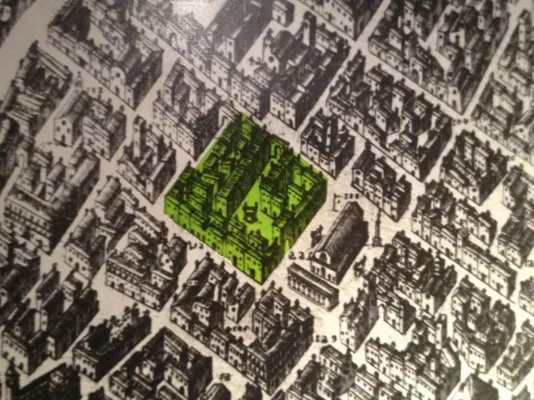
Gabriele Mancuso, Director of the Eugene Grant Jewish History Program at the Medici Archive Project, recently spoke with Barbara Faedda, Executive Director of the Italian Academy, for a published print interview about the segregation of Tuscan Jews and the creation of the Ghetto of Florence.
(This is not be an in-person event; our commemoration is the publication of an interview transcript.)
Europe and the UN commemorate Holocaust victims each winter on the anniversary of Auschwitz's liberation in 1945. The Italian Academy observes Holocaust Remembrance Day by examining the historical origins of antisemitism, racism, and xenophobia—particularly under Nazi and Fascist regimes—while also confronting modern forms of hatred, Holocaust denial, and misinformation. Throughout the years, the Academy has broadened its focus to also explore groups that were targeted by the Nazi and Fascist regimes, and who were persecuted and killed in addition to the six million Jews. In this and other years, we have published fresh interview transcripts; on some occasions we have hosted public talks; read here about all the previous Remembrance Initiatives at the Academy since 2008.
Read our new interview transcript below: January 2026 exchange with Gabriele Mancuso
Barbara Faedda:
Last year we focused on the first ghetto in Italy, established in Venice in 1516. Years earlier, we also explored the Rome ghetto, established in 1555. This year, we wish to learn about the Florence ghetto so as to broaden and deepen our understanding of these important and complex chapters of Italian history. I would like to begin by asking you to provide a brief overview of Jewish life in Florence prior to the ghetto’s establishment, and to explain the circumstances that led to the discrimination, persecution, and confinement of the Jewish community.
Gabriele Mancuso:
First of all, I want to thank you for this invitation, for which I feel truly honored. Your question is very interesting, but demanding, because the history of the Jews of Florence before the ghetto in many respects follows trajectories similar to those of other Jewish groups in Tuscany and, more generally, in Italy. The earliest evidence of Jewish presence in Tuscany dates back to the early Middle Ages, a time when Jews originally from central Italy (above all from the Lazio region and Rome, the first and oldest diasporic settlement), as well as families from the South, arrived in this area. We are talking about groups that were always numerically very small, proportionally marginal compared with the majority population, but with a remarkable cultural “force.” The most significant example is that, as I said, of the Jews from Puglia, who between the tenth and eleventh centuries settled, according to what some Jewish sources tell us, in the territory of Lucca, then proceeded to the German-speaking lands, particularly the Rhenish regions, where they established important schools of thought both rabbinic and mystical, developing reflections and ideas that they had carried with them from the aforementioned southern Italy. In Tuscany, as indeed in much of the Italian Peninsula before the creation of the ghettos, the profile of Jewish presence is represented by small groups, often made up of a few families, scattered throughout the Tuscan territory—a sign of a degree of tolerance that perhaps did not exist elsewhere. I insist on this point: we are faced with a community made up of small groups, almost “points” on the map, that integrate with the majority society, that share spaces and ways of life (including naming practices, which for these Jews are often of Latin origin), but that are capable of endowing themselves with a potential—a really strong cultural “charge.” To understand what this means, I note as examples the prayer books—in Hebrew, siddurim and mahzorim—that these families had copied by skilled Jewish scribes—to ensure that there were no textual or ritual problems—but that they commissioned to be decorated by Christian artists, often the most renowned representatives of that part of Italian art. In these texts, which from a textual point of view conform perfectly to what orthodoxy dictates, we find moments of great freedom, such as prayer books where the blessings—traditionally written in the masculine gender—are rendered in the feminine, thus anticipating innovations that the Jewish world (at least its more progressive components) would adopt only in the second half of the 1900s. We are not talking about a “perfect” coexistence, because some things are still present: strong prejudices, and the “canonical” laws that impose and sanction every form of coexistence between Jews and Christians, and the preachers who like to stir up crowds against the perfidious “Jews” (cast as bearers of spiritual deviance and material disease), but—on the whole—there are no acts of particular gravity reported. Clearly acts of intimidation and, unfortunately, episodes of outright ferocity do occur (the most serious took place in Florence in 1493, the year in which poor Bartolomeo de Cases, a Sephardic Jew, was killed by a mob gripped by antisemitic hatred), but, as I said, if placed on the scales of history, the balance would—forgive me for the great simplification—tip toward tolerance.
The more complex and for me more interesting part—because I have devoted several years of study to it—of your question concerns the circumstances that led to the change of tone and thus to segregation in the ghetto. There are many elements we could identify in this process. On the one hand, first and foremost, I would say a general climate of hatred that arises not so much from the invention of the ghetto as a “system” (indeed one might say that the ghetto is the expression and epiphany of a way of thinking) as from a growing sentiment of anti-Jewish hatred, a fire that feeds on the one hand on feelings never fully extinguished within Christian society (from the blood libel accusation to the leitmotif of deicide) but that finds a very strong source of inspiration in the policies that the Counter-Reformation Curia adopts towards the heterodox. From this category—which should include only non-aligned Christians—Jews should be excluded, as they belong to something “other”; but over time an “expedient”—excuse the word—is found to make them fit: they represent an otherness that does not resolve, a paradox, because while representing a fundamental component of the history of salvation, the Jews “persist” (a verb typical of theological discourse) in not believing, thereby setting a bad example—so to speak—for the ordinary Christian who cannot understand how their condition of spiritual subordination does not also manifest itself in a condition of material inferiority. If this, of course, does not occur, the Church concludes, it will be necessary to impose it by law. Looking at late-sixteenth-century Tuscany, to be more specific, there is a duke, Cosimo I de’ Medici, who, lacking a true family tradition and belonging in reality to a marginal branch of those Medici who were the protagonists of the Renaissance in Florence, will try to obtain from the empire and the papacy a dynastic “surplus.” He obtained this from the papacy in 1570, the same year in which he decided to impose segregation in ghettos on all the Jews residing in Tuscany. This was, in reality, only the end of a process of gradual rapprochement with the Curia that implied an equally gradual narrowing of freedoms for the Jews, who from 1567 were forced to wear a distinguishing element, normally yellow, also called the “Jewish sign,” and were then excluded from professions and trades.
BF:
The Florence ghetto and the history of Jews in that city are quite distinctive, particularly given their close connection to the Medici family. Would it be accurate to say that examining this community also offers a new and critical perspective on the celebrated image of the Medicis? You have noted that “the Jewish ghetto of Florence is one of the great absentees from the Florentine Renaissance narrative.” Could you explain why this is the case?
GM:
I will answer your question by starting with your last point, which concerns the relative “marginality” of the Florence ghetto in the broader history of Italian Jews. I will refer to some data, pure numbers, because demographics tell us a lot. At the end of the 16th century, when Cosimo began to think about how to resolve the “Jewish question,” there were just over 700 Jews in the entire Medici state—a territory that Cosimo himself had enlarged to include Siena and other originally independent territories—711, to be precise, a very small community indeed, especially when compared to the Jews who in those same years were living in the ghettos of Venice (1516) and Rome (1555). In Florence itself—where a formally recognized Jewish group had settled in 1437, thanks to Cosimo the Elder—there were about 80 people in 1567, so here too, a very small community, which is really interesting considering the importance of Florence in the peninsula as a whole.
Cosimo, who knew and personally frequented some Jews (many of them through his wife, Eleonora da Toledo, daughter of the Viceroy of Naples), saw ghettoization as an opportunity to “normalize” his role as ruler, adopting the system of segregation, albeit with significant peculiarities. Rather than historical “marginality,” I would speak of “historiographical marginality,” because until very recently—the early 2000s—there were only brief references to the Florence ghetto, pieces of memory scattered through local history and Jewish history, lacking a clear and continuous narrative. It is significant, for example, that the great historical investigation conducted by the major historian of Florentine Judaism, Umberto Cassuto, covered the Middle Ages and the Renaissance, stopping precisely at the threshold of the ghetto. I do not think we can say this is a true voluntary omission, because at the time the archival sources were only partially known (although always sufficient for talking about the ghetto...), but I believe that this silence was a way of not returning to ancient “shame,” of projecting a religious community, which in Florence experienced one of its main cradles of national emancipation, toward a past of marginalization and great poverty. Last but not least, the ghetto of Florence remained in the shadows, so to speak, also perhaps because it was completely destroyed, demolished, and removed not only physically but also from the memory of both the city of Florence, as a whole, and the Jews as a religious community.
BF:
How did life in the Ghetto evolve over the centuries before its dissolution? Jewish contributions to Florentine life have been significant across many domains; where do you see this influence most profoundly?
GM:
Life in the ghetto, the “silence” of the sources tells us, was tranquil, governed by the same rhythms and the same habits that marked the passage of time in the city as a whole. The ghetto, originally inhabited mainly by Jews of Italian origin and rite (the so-called Italkim), was a place perfectly integrated into the urban fabric, as it was located—this is the great paradox—right in the very center of the city, just a few minutes from Palazzo Vecchio and only a few meters from the Duomo, the fulcrum of the city’s Christianity. To this Italian Jewish component—one should really speak of a “nation”—there was soon added a so-called “Levantine,” Sephardic component, which, unlike in other ghettos—I am thinking of that of Venice, my city of birth—played a lesser role in comparison with the Italian component.
For more than two centuries the ghetto was the hub of Florentine Jewish life, a place whose primary purpose was to divide and segregate but which, over time, as can also be observed in other Italian areas, became a place of encounter as well, a sort of laboratory where a Jewish identity was formed and where important moments of interaction also took place. From what has emerged in recent years thanks to meticulous archival research, from the middle of the seventeenth century and certainly until the first decade of the following century, the ghetto largely ceased to function, in the sense that a growing portion of the population moved outside the ghetto—transgressing both state laws and canon law—albeit always into adjacent areas. We are speaking of a residential “hemorrhage” that involved about half of the Jewish population (more than one hundred families, therefore certainly more than 400 people), toward which—whether out of self-interest or for the sake of peaceful coexistence, we may presume—the Christian neighbors raised no accusations, evidently considering it normal—as it should be—that Jews and Christians should return to living in a shared space, beyond barriers and divisions.
This, then, is another element that makes the Florentine ghetto both unique and—allow me the expression—largely (fortunately) unsuccessful, failing to contain phenomena of human interaction. At the beginning of the eighteenth century, as Europe was moving toward the age of reason and the Enlightenment, Grand Duke Cosimo III ordered the reintegration of the Jewish population within the ghetto and thus the expansion of the area created by his predecessor Cosimo I. In this case as well, the time that elapsed between the grand-ducal order and the completion of the works (1704–1715) shows how segregation was, in fact, anachronistic, even though imposed from above and officially always in force.
As happened in other peninsular contexts, in addition to the dramatic exodus of the mid-seventeenth century, processes of profound interaction developed between the ghetto and the city, ranging from material ones involving the lower proletariat—of which we find evidence in the records of the Roman Inquisition and of the Medici police authorities—to those among Jewish and Christian intellectuals, some of whom were convinced that Hebrew, which they had learned from rabbis and teachers within the ghetto, was the root of the Etruscan language and therefore the fulcrum from which local culture developed. It is evident that these were hypotheses entirely up in the air, devoid of any foundation whatsoever, but they nonetheless reveal a truly unique cultural climate.
BF:
How was the Florence ghetto similar to or different from other ghettos in Italy? Rome’s ghetto was intended to expedite conversion and cultural dissolution, but—according to historian Kenneth Stow—it had the opposite effect. You have written that “the ghetto of Florence was certainly a place of segregation and social exclusion for Jews, but also the site of a variegated human microcosm that gave life to complex processes of internal interaction, also with the social majority.” Could you provide some concrete examples of these interactions?
GM:
I think that at least some of these questions I have already answered earlier, so, if you agree, I would now focus on what is perhaps the most peculiar characteristic of the Florentine ghetto, namely the fact that it was the private property of the Medici. When I talk about this in public, I often see contrasting reactions to this statement: some people think it is perfectly normal and obvious (after all, the Medici, as grand dukes, were the autocrats of the moment who could do and demand anything), while others show almost signs of surprise. What does “private property” of the Medici mean? It means that the ghetto, established on the advice of Carlo Pitti, a zealous bureaucrat and a terrible antisemite, was built on houses that already existed, largely of early medieval origin if not even earlier, owned by various Christian proprietors and of very low value. Once the houses had been confiscated by the state—and the owners’ debt partially reimbursed with sums forcibly deposited in the Monte di Pietà, at the time a Medici financial instrument—the ownership was transferred from the state to the Medici, becoming private property.
This triangulation has its rationale and is not political in nature but purely economic: the ghetto was meant to house a population to whom no alternative was given (leaving the grand duchy was possible, but which Italian state or Mediterranean power would have accepted them while offering better conditions?), a population necessarily growing and on whom taxes and rental contracts were imposed that were normally 30% to 50% higher than those in the rest of the city. Between leases, rents, taxes, and duties, despite the fact that the Jewish population was forbidden to work in the main professions or to lend money, the ghetto proved to be a very profitable investment for the Medici, a sort of economically defined space that produced a subsistence economy and required services that only the Christian population could provide. Thus, while on the one hand that of Florence is a “minor” ghetto, from an administrative point of view it is an absolute unicum. Being private property of the Medici, like any other palace, castle, hill, villa, or landed estate, the ghetto was subject to constant, almost obsessive supervision, both from an economic-administrative and from a cadastral-cartographic point of view. For us scholars, a true godsend.
BF:
You have conducted extensive archival research for many years and discovered valuable documents. What have these previously unseen documents added to our historical understanding of Jewish history in Italy and Europe? What is their major contribution?
GM:
As stated earlier, since it was a grand-ducal property and not “merely” of the Medici state, today we know a great deal about the Florentine ghetto. The question I often ask myself, and to which even today I cannot give a rational answer, is why this did not emerge earlier. When we began the study of the Florentine ghetto and announced the examination of the Medici papers—an appeal to which only one professor from the Italian academic community responded—the answer, I would dare say the most recurrent leitmotif, was that everything was already known and studied and that nothing new would emerge.
The documents that we identified and studied have taught us many things that were not known, they have revealed a thousand small stories that had been lost to memory, but if I had to say what truly struck me, it is the image of the ghetto that emerged. The ghetto, although an area of marginalization, was not the gloomy and decaying place that was described at the end of the nineteenth century, when its demolition was decided. The ghetto was a varied microcosm, certainly with dilapidated dwellings where a single room might house two families, but also with decorated spaces, with stuccoes and frescoes (clearly, we are speaking of a minority portion), where celebrations were organized and oratorios, melodramas, operas, and chamber music were performed.
Beyond this, beyond the so-to-speak material aspect, what we have understood is that segregation arises from deep ideological factors; it is the direct manifestation of centuries of prejudice, but also the result of an economic calculation, of a political and financial calculation that, in fact, enriches elites and harms the poorest classes, indigent not because they are incapable of climbing the social ladder but because they are prevented from doing so. Now, I do not want to extend this judgment to other situations, I do not want to generalize and say that this applies to other ghettos, nor even to project this onto the present day, but personally I am convinced that certain human phenomena are, at the end of the day, more or less always the same.
BF:
Regarding Florence specifically, could you help us understand the different timeframes, locations, and designations associated with the concepts of the ghetto vecchio, ghetto nuovo, ghetto esterno, and ghetto interno?
GM:
When studying the history of the Florentine ghetto, as with any specific subject, it is important to make certain distinctions, including at the linguistic level. By “old ghetto” one means the ghetto that was created by Cosimo I de’ Medici in 1570, whereas by “new ghetto” one means the area that was established at the behest of Cosimo III in 1704, north of that of the already existing ghetto, and which officially came into operation in 1715.
Somewhat more complex is the distinction between “external ghetto” and “internal ghetto,” something truly unique and peculiar that we do not find in any other ghetto in Europe. The “external ghetto” was the result of a solution devised by Carlo Pitti: to resolve the truly striking paradox of a ghetto—thus a zone of marginalization—placed right within the historic center and therefore immersed in the fabric of Christian society, Pitti advised creating a kind of buffer zone made up of shops and dwellings located along the outer part of the perimeter of the palaces where the ghetto would arise, and which would be designated and leased to Christians. This buffer zone would “hide” the internal ghetto, that is, the ensemble of dwellings, shops, and public spaces intended for the Jewish presence.
It should be borne in mind that the ghetto area, in addition to sitting close to spiritual and political epicenters, looked onto the area of the Mercato Vecchio, which in the medieval period and in the sixteenth century was one of the city’s main zones of exchange and trade.
BF:
Florence ghetto was formally dissolved in the nineteenth century, and its physical structures were demolished as the city modernized. How has this material loss affected collective memory and the historical understanding of this community?
GM:
Thank you very much for this question, because we have reflected a great deal on this point. The demolition of the Ghetto falls within a late-nineteenth-century urban reordering plan through which the municipal administration intended to transform Florence into a “genuinely” Italian city, something that at the time was taking place in all the major European cities. Florence, as is well known, had for some years been the capital of the Kingdom of Italy, and the sense of renewal remained strong even when this role was transferred to Rome after the breach of Porta Pia. A truly substantial portion of the historic center—including churches, ancient palaces, medieval-era dwellings, and Renaissance buildings—was completely demolished, as were the city walls.
It was a complex plan, highly controversial, strongly criticized by foreign intellectuals, but, as often happens, viewed in a perhaps insufficiently critical way by a large part of the Italian ruling class, both in Florence and in the rest of the peninsula. Demolishing the ghetto, moreover, was seen as an almost reparative act toward a minority that had objectively suffered segregation and marginalization and that, thanks to the unified Kingdom and its first king (Vittorio Emanuele II), had gained civil and citizenship rights that it had never previously enjoyed. The demolition of the ghetto—and this is an additional element—was welcomed by part of the progressive-leaning ruling class as an almost obligatory act: after the Jews had left the ghetto, it had been inhabited by the lower proletariat, made up of the most marginalized elements of society, minor and major criminals, prostitutes, and families with no income whatsoever and no hope.
The material disappearance of the ghetto, as I mentioned above, could not but entail, given the premises I referred to earlier, an almost total obliteration of the history of the ghetto itself and of a large part of the history of its community.
BF:
Exclusion and violence against the Jewish communities of Florence and Tuscany did not end with the abolition of the ghetto. In the first half of the twentieth century, these communities became targets of Nazi and Fascist discrimination, persecution, and deportation. Today, while many people value Holocaust Remembrance Day, others question its relevance and impact. What is your perspective on this, and how can such commemoration remain meaningful across generations? How can it continue to serve as a powerful tool for transmitting memory and historical awareness?
GM:
In recent years, especially since the outbreak of the war in Gaza, forms of antisemitism that we thought were by now a relic of the past have resurfaced in all their violence. It is not that we did not know this—no one ever truly believed that anti-Jewish hatred had been eradicated—but we thought, perhaps with excessive confidence, that Western societies were capable of equipping themselves with antidotes, which has proved utterly mistaken. The war has, on the one hand, reactivated old nodes of hatred—the classic, old-style kind that depicts the Jew as a demonic creature and a tormentor of peoples—and, on the other, given rise to new forms of antisemitism, which do not draw (at least in appearance) on the classic ideological trash such as The Protocols of the Elders of Zion or Hitlerian writings, but on texts, pamphlets, and analyses produced at a desk without even minimal knowledge of real data and facts (which are necessary when speaking about a conflict). These have systematically offered narratives and historical accounts that are entirely partial, in which elements that do not fit certain ideological assumptions are systematically omitted.
By visiting schools, where I often go to speak to very young students about Judaism and Jews, I realize that what they know is conveyed, on the one hand, by media in which the compression of ideas—forced into the few seconds of any social-media video accessible on a smartphone—leads to “freeze-dried” forms of knowledge, and, on the other, by the voices of those who, able to gather information that is vaguely more articulated, improvise themselves as expert speakers, then move on to the role of outright indoctrinators, who cannot be challenged and who play the role of new gurus. This process is taking shape across old social categories, affecting both those who unfortunately lack the tools to analyze complex facts and intellectuals as well—individuals who should know how to distinguish facts from opinions, slogans from objective truths. The willingness to delve deeper, not to mention to criticize, is considered an act of defiance, an insult to icons that masses of worshipers regard as holy, perfect, and therefore untouchable. The primary tool in this war against hatred remains knowledge: to “take sides” with complexity and to reject every form of uncritical thinking, not to surrender in the face of the black tide of those who spread prejudice. I do not know exactly what will remain, or what shape these new forms of hatred will take; I imagine them as a great black cloud that, over time, will lower itself—not to disappear, but to settle upon us, on our skin and on our lives. By instinct, by nature, I am an optimist, but I often ask myself what will become of the memory of the Shoah, given that many—those whom we once considered trusted companions on the journey—have, without too much difficulty or hesitation, decided to draw a straight line across the furrow of history and leave behind, with an unmistakable sense of relief, the memory of the Shoah.
BF:
The younger generations have a crucial role in combating racism, antisemitism, and discrimination. Regarding Holocaust Remembrance Day 2026, do you have a particular message for young people—in the US, in Italy, and throughout the world?
GM:
More than a message, I would like to make a real “call to arms”—forgive the expression, which I obviously use in a metaphorical sense—and ask those who believe in individual freedom and in collective freedom (ours and—above all—our children’s) to come together in a shared space, centering the value of the person and the person’s dignity. Memory is not a rhetorical exercise, nor is it a moral “token” to be paid; it is an instrument of freedom that allows us to look at the world from a broader perspective while also knowing how to distinguish what is true from what only appears to be reality.
I often hear it said, especially by colleagues in academia, that we are living in a “period of crisis,” an expression that is used so frequently that it has almost lost its meaning. Instead of “crisis,” I propose thinking of a mosaic whose tiles are moving: at first this makes the accustomed images disappear, but their recomposition can give shape to something entirely new—it is up to us whether it will be something good or not. In this very fluid moment, in which everything seems evanescent and formless, those who have memory prevail, because they are able to perceive even what is not visible at first glance and to imagine new forms.
I am not among those who cry out every day about the authoritarian danger, because I think that none of us is truly willing to lose, at least consciously, even a crumb of the freedom we enjoy (often so much so that we do not even realize how the rest of the world actually lives), and I am convinced that the old styles and symbols and ceremonies will no longer be seen. Can you imagine what would happen if we were all commanded by the regime to do Saturday rituals (as in Fascist times): military workouts and other such nonsense? And what if, instead of choosing what job to do, we had to wait for an anonymous bureaucrat to assign us to an employment we hate for our entire lives? Would we be willing, in the name of the common good, to renounce any personal aspirations? I think that we would rebel over much, much less.
I also believe, however, that there exist behavioral patterns, individual instincts—the same ones that then go on to form the deepest character traits of our societies and then of the states to which we belong—that, outside a context of civil coexistence, can translate into acts of violence and profound hatred. Nazism, just to be clear, did not arise in an underdeveloped country but, paradoxically, in a nation that had a very rich cultural tradition and that excelled in the scientific, artistic, and philosophical worlds. It will not be I today who explains how a regime arises—people infinitely more prepared than I have tried—but it seems to me to be a shared fact that wherever forms arise in which instinct becomes a method of domination and a form of government, every prerogative of civilization falls away.
States, yesterday as today, are not abstract entities; they are agglomerations of individuals, of people who freely decide what their life priorities are and how to position themselves toward others. The Day of Remembrance is not a ritual nor is it an apotropaic act with which we ward off the rise to power of an autocrat; it is an act of awareness, through which remembrance becomes an absolute, non-negotiable value. Those who remember and have a true awareness of what has been—and here I resort to a nautical metaphor, because I am Venetian—are like a ship with a deep hull that is not overwhelmed by waves and swells. Remembering and knowing what has been is right, without doubt; it is a moral duty, but it is also useful and, I hope I will not be misunderstood, also something profoundly beautiful and fascinating, because it places our lives and our tomorrow within a human, civic, and ideal narrative that is much greater than ourselves.
Thank you very much for this conversation; it has been a real pleasure!
Image courtesy of the Eugene Grant Jewish History Program, Medici Archive Project.