Walk-in: 11 AM to 4 PM
Join us to view a video created and presented by Ludovico Centis (Weinberg Fellow in Architectural History and Preservation, Italian Academy)
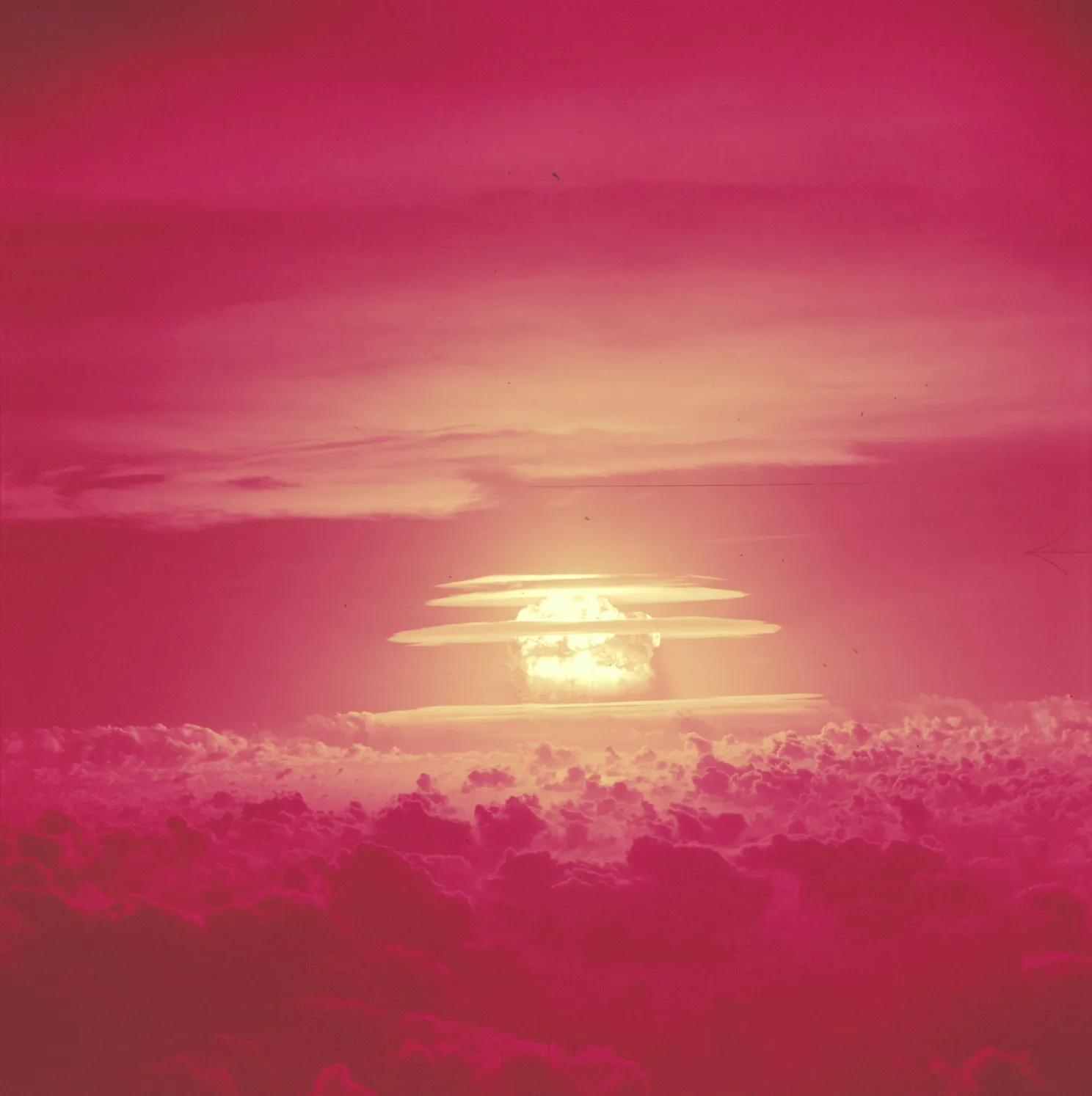
The U.S.A. did 1,054 nuclear tests from 1945 to 1992. The test names were drawn from the "Able Baker alphabet" (the phonetic system used in Army and Navy radio communications). After 1952, the Able Baker alphabet was dropped—to avoid repeating test names. This led to a seemingly random sequence of names.
This 15-minute video has an abstract soundtrack produced by Michele Marchetti/STRA. It was developed as part of the classwork for “Monument, Testimony, Protest” (Prof. Krzysztof Wodiczko, Columbia Graduate School of Architecture, Planning and Preservation).
Ludovico Centis spent the Spring term at the Italian Academy as a Weinberg Fellow in Architectural History and Preservation.
He is an architect, founder of the firm The Empire, and co-founder and editor of the architecture magazine San Rocco. He received a PhD in Urbanism from Università IUAV di Venezia.
During his stay at the Italian Academy, Centis engaged with the material and immaterial legacy of the Manhattan Project, and in particular with the joint development by Columbia University and the University of Chicago of the first atomic pile—the Chicago Pile 1 (CP-1). Under the guidance of Italian physicist Enrico Fermi, CP-1 went critical on December 2, 1942: the birth date (some say) of the Atomic Age.
Co-Sponsor
The Sidney J. Weinberg Jr. Foundation
FULL BIOGRAPHICAL NOTES
Ludovico Centis is an architect, founder of the firm The Empire, and co-founder and editor of the architecture magazine San Rocco. He received a PhD in Urbanism from Università IUAV di Venezia. His research focuses on the ways in which individuals and institutions, as well as desires and power, shape cities and landscapes.
Centis was a partner at the firm Salottobuono from 2007 to 2012; the firm acted as Creative Director of Domus magazine between 2011 and 2012. He was the 2013–14 Peter Reyner Banham Fellow at the State University of New York–University at Buffalo. During the spring of 2015 Centis was at the Center for Land Use Interpretation as a participant in the Wendover Residence Program. He was awarded a 2018 Getty Library Research Grant at the Getty Center in Los Angeles and a 2020 Research Support Grant from the Paul Mellon Centre for Studies in British Art – Yale University.
Centis has taught at Università Iuav di Venezia, at Politecnico di Milano and at the State University of New York–University at Buffalo. Most recently, he was a postdoctoral research fellow at Università IUAV di Venezia and a Visiting School Head at the Architectural Association School of Architecture in London between 2020 and 2022.
Centis has lectured widely in international universities and venues, such as the Hong Kong & Shenzhen Biennale of Urbanism, the Palais de Tokyo (Paris), Technische Universität Wien (Vienna), the Architectural Association (London), Cornell University (Ithaca, NY), Princeton University (Princeton, NJ), Bauhaus-Universitaet (Weimar), the University of Chicago, the Beijing University of Civil Engineering and Architecture, the Kyoto Institute of Technology.
Centis has published essays and papers in refereed journals such as Domus, Town Planning Review, Landscape Journal, Log, OASE, San Rocco, Topos, Arch+, AA Files, and Harvard Design Magazine. Recent books include Reyner Banham: A set of actual tracks (2024, editor), Qualche sembianza e immagine di bellezza. Spazi pubblici e città costiere globali (2024, co-edited with Matteo D’Ambros), The Lake of Venice. A scenario for Venice and its lagoon (2022, co-authored with Lorenzo Fabian), and A parallel of ruins and landscapes (2019).
More information: theempire.eu
Image: Bravo Test, Operation Castle, Mar/node/29ch 1, 1954. Courtesy Los Alamos National Laboratory